In British Columbia, railings and guards are a life-safety item. If they don’t meet code, you don’t get occupancy, and you don’t get sign-off. Inspectors are focused on four things: when a guard is required, how high it must be, how strong it is, and how safe its openings are.
This guide breaks down what’s actually enforced on decks, balconies, and stairs in B.C., and how working with a qualified fabricator keeps you out of trouble.
1. When do you legally need a guard or railing?
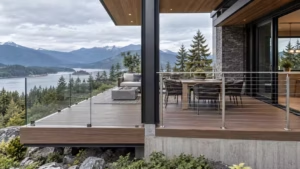
In B.C., a guard (often called a guardrail) is required anywhere there’s a walking surface with a drop of about 600 mm / 24 inches or more to the next surface below. This applies to decks, balconies, elevated landings, and similar platforms.
In practice:
- Ground-level patios with almost no drop may not require a guard.
- Second-storey decks, roof decks, balcony edges, and elevated exterior walkways almost always do.
If you get this call wrong, you’ll either fail final inspection or be forced into a last-minute install.
2. Required railing / guard height
B.C. code and municipal building bylaws set different minimum heights depending on where the guard is installed.
Typical requirements used in B.C.:
- 1070 mm (42 in) minimum height for most exterior guards and for guards serving public/commercial/common areas.
- 900 mm (36 in) minimum height for guards within a single dwelling unit and certain low residential conditions, such as exterior guards serving not more than one dwelling unit where the walking surface is not more than 1.8 m above grade.
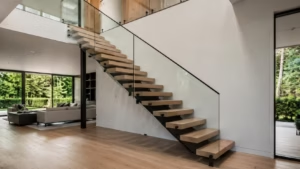
- On stairs: guards along the open side of a stair run can be as low as 900 mm (about 36 in), measured vertically from the line of the stair nosings up to the top of the guard.
Inspectors measure vertically. If you’re off by even 10–20 mm, you can be tagged. That’s why a site-measured, fabricated system (not a generic kit) matters.
3. Opening size and climbability
Even if your guard hits the right height, you can still fail if the openings aren’t safe.
Two key tests are used in B.C. and in Canadian code practice:
- 100 mm rule: no opening in the guard should allow a 100 mm (about 4 in) sphere to pass through. This applies to pickets, glass panel gaps, spacing under the bottom rail, etc.
- No built-in ladder: guards in residential settings are not supposed to “facilitate climbing” within roughly the first 900 mm above the walking surface, because that creates a fall hazard for children.
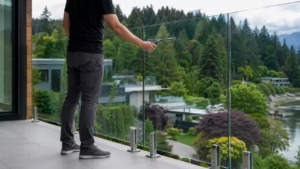
This is why frameless or post-supported glass railings are so common in modern BC construction: a continuous glass panel satisfies the 100 mm opening limit without creating horizontal ladder rungs.
Note: some local code updates now allow certain horizontal railing systems (e.g. cable rail / horizontal rods) in parts of B.C. and Vancouver, but they still have to meet height, opening, and structural rules.
4. Structural strength and load rating
Your railing is considered a structural safety element — it is not decorative. Inspectors will ask, implicitly or directly: “Will this guard hold if someone falls into it?”
B.C. code and Vancouver’s building bylaw reference minimum load resistance for guards. Typical requirements include:
- A uniform horizontal load along the top of the guard (for example, 0.75 kN/m in most cases for standard guards).
- A concentrated load of 1.0 kN (roughly the force of a person hitting the rail at one point) applied at any location on the guard.
- Localized loading on individual elements (pickets, glass panels, posts) without permanent deformation.
That’s one reason inspectors are wary of improvised, site-built railings with unverified welds or off-the-shelf “homeowner fixes.” The guard has to be engineered to resist real impact, not just look good.
5. Handrail vs guard: inspectors treat them differently
A handrail is what you hold while moving up and down a stair. It needs to be graspable and is usually placed between roughly 865 mm and 965 mm (34–38 in) above the stair nosing in residential settings, depending on the specific code clause.
A guard is a fall-prevention barrier at the open side of a stair, landing, deck, or balcony. Guards follow the 900 mm / 1070 mm height logic above and the 100 mm opening rule.
On many stairs you need both. On elevated decks you always need the guard; a handrail may not apply unless there are stairs.
This is a common DIY fail: installing a “nice-looking” top rail and assuming that covers code. It usually doesn’t.
6. Why using a certified fabricator matters
Under CSA Standard W47.1, companies that weld structural steel in Canada can be certified by the Canadian Welding Bureau (CWB). To obtain and maintain that certification, the company must qualify welding supervisors and welding engineers, submit welding procedures for review/approval, and ensure welding personnel are tested and qualified on an ongoing basis.
For you, that means:
- The railing or guard you’re installing isn’t guessed together on site.
- Welds and connections are backed by documented procedures, not guesswork.
- You’re less likely to get flagged for “non-structural” railing work at final inspection.
In short: hiring a CWB-certified fabricator is a direct path to structural compliance and inspection confidence.
7. How to pass inspection the first time
Here’s the playbook we use and recommend:
- Confirm early if you need a guard.
Measure the drop. If it’s ~600 mm (24 in) or more, plan for a code-compliant guard. - Lock in height targets.
- 1070 mm (42 in) for most exterior/common spaces
- 900 mm (36 in) for certain residential and stair conditions
- Respect the 100 mm rule.
No 4-inch gaps, no climbable “ladder” sections in the first ~900 mm. Frameless glass or properly spaced pickets solve this. - Ask for load data.
Your installer should be able to demonstrate that the guard assembly can resist 0.75 kN/m uniform load and 1.0 kN point load, which reflects real-world impact. - Use qualified welding and fabrication.
A CWB-certified fabricator has documented welding procedures and qualified personnel — exactly what inspectors and engineers expect to see.
Do those five things and you’re not scrambling at the end of the job.
Final Talk
If you’re building or upgrading a deck, balcony, exterior stair, or commercial guard system in the Lower Mainland, Squamish, or Whistler, get in touch before framing is closed. We’ll measure on-site, engineer to B.C. code height and load requirements, fabricate in-house, and install a system that clears inspection and looks intentional.
Call (604) 971-6633 or email stanglassworks@gmail.com to book a site review.